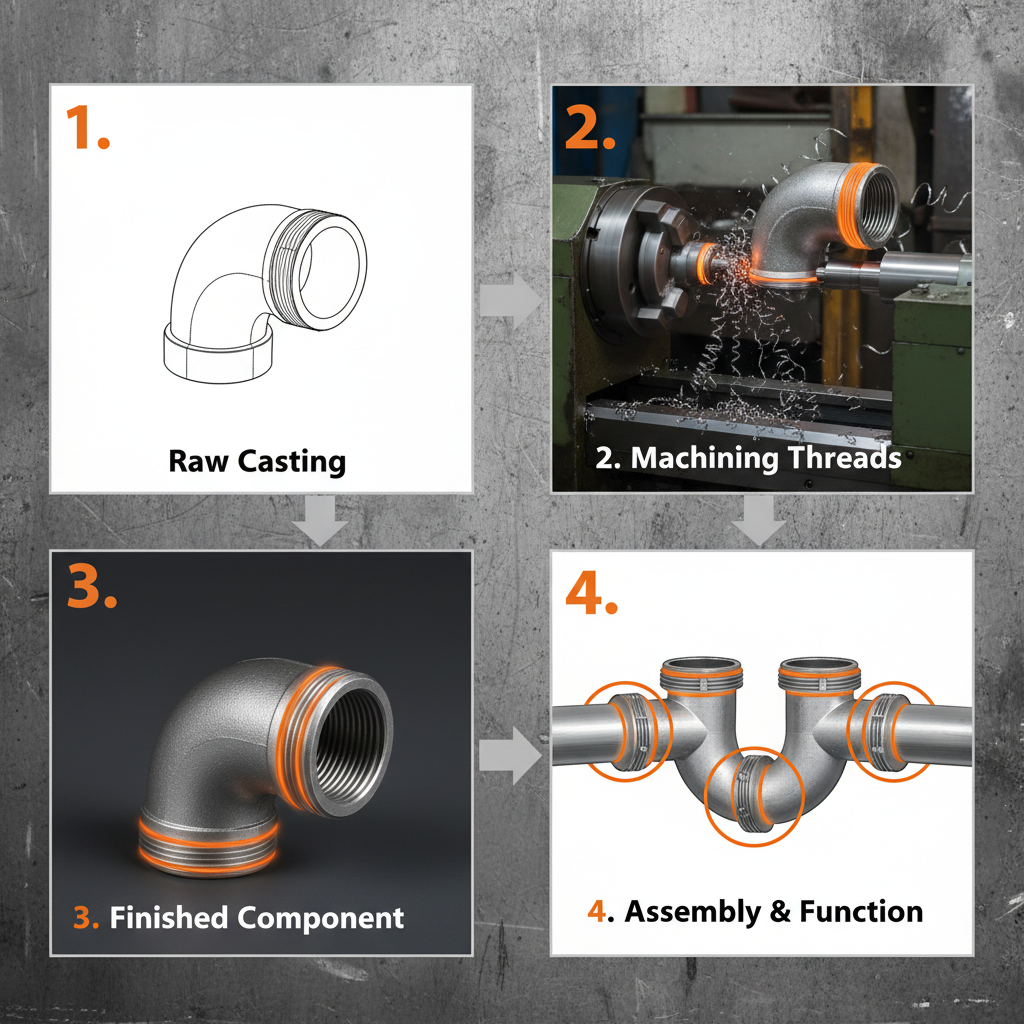
In the complex world of industrial piping, the bspt thread standard serves as a critical blueprint for ensuring leak-proof connections and mechanical integrity. British Standard Pipe Taper (BSPT), also known as R threads, is engineered specifically to create a seal through the interference fit of tapered threads, making it indispensable for high-pressure fluid and gas transmission systems.
Understanding the nuances of the bspt thread standard is not merely a technical requirement but a global necessity for interoperability. From oil rigs in the North Sea to chemical processing plants in Southeast Asia, the ability to match a male tapered thread with a female tapered or parallel thread ensures that infrastructure remains safe, sustainable, and easy to maintain.
For procurement managers and engineers, mastering the bspt thread standard minimizes the risk of catastrophic failure and costly downtime. By adhering to these precise geometric specifications, manufacturers can produce high-quality Bronze pipe Fittings and Malleable Iron Pipe Fittings that meet the rigorous safety demands of modern industrial applications.
Global Industrial Relevance of BSPT Thread Standard
The global adoption of the bspt thread standard mirrors the expansion of international trade and engineering collaboration. According to ISO standards and regional industrial data, the BSPT system remains a dominant force in Commonwealth nations and beyond, bridging the gap between legacy infrastructure and modern high-pressure requirements. The primary challenge it addresses is the "leakage paradox"—where higher pressures often lead to higher failure rates at the joints.
By implementing a standardized taper, the bspt thread standard ensures that as the fitting is tightened, the mating surfaces are forced together, creating a mechanical seal that is far more reliable than parallel threads alone. This global synchronization allows a Class 300 Pipe Fitting manufactured in one continent to integrate seamlessly into a system installed in another, reducing the need for custom adapters and lowering total project costs.
Technical Definition and Mechanical Meaning
In simple technical terms, the bspt thread standard describes a pipe thread that is tapered at a ratio of 1:16. This means the diameter of the thread decreases gradually along its length. Unlike parallel threads (BSPP), which rely on a gasket or O-ring for sealing, BSPT threads seal via the "crushing" of the thread flanks against each other, often supplemented by a thread sealant or PTFE tape to fill microscopic voids.
This mechanical design is intrinsically linked to modern industrial needs for safety and speed. In high-stakes environments like chemical manufacturing or oil extraction, the ability to achieve a pressure-tight seal without complex gaskets simplifies the assembly process and reduces the number of potential failure points. The standard provides clear guidelines on pitch, diameter, and taper angle, ensuring that every "male" and "female" component fits with mathematical precision.
Beyond the geometry, the meaning of the bspt thread standard lies in its versatility. Whether applied to Bronze pipe Fittings for corrosion resistance or Coated Pipe Fittings for harsh environments, the threading logic remains constant. This consistency allows engineers to design complex piping networks with the confidence that the fundamental connection points will withstand the operational stresses of the system.
Core Components of Tapered Thread Integrity
The first pillar of the bspt thread standard is Geometric Precision. The 1:16 taper is not an approximation but a strict requirement. Any deviation in this angle can lead to "point loading," where the stress is concentrated on a small area rather than distributed across the thread, potentially leading to cracks in brittle materials like Malleable Iron Pipe Fittings.
Secondly, Material Compatibility plays a vital role in how the bspt thread standard performs. The interaction between a hard steel fitting and a softer bronze fitting requires a deep understanding of galling. By selecting the correct material grade, manufacturers ensure that the threads deform slightly to create a seal without compromising the structural integrity of the joint.
Finally, Sealant Integration is the third core component. While the bspt thread standard provides the mechanical wedge, sealants provide the hermetic barrier. The use of professional-grade compounds ensures that the tapered fit is optimized, preventing "over-tightening," which can distort the threads and lead to premature failure.
Performance Metrics of BSPT Thread Standard
Evaluating the efficacy of the bspt thread standard requires looking at objective performance metrics. In real-world stress tests, tapered threads consistently outperform parallel threads in high-vibration environments. The wedge-like action of the BSPT design prevents the fitting from loosening over time, a feature that is critical for Compression Coupling and other heavy-duty industrial connectors.
When comparing different implementation methods, we see that the precision of the tooling and the quality of the raw materials significantly impact the final rating. For instance, a precision-machined BSPT thread in a Class 300 fitting offers superior pressure ratings compared to cast-in threads. The following chart illustrates the comparative performance ratings of various BSPT application methods across key industrial metrics.
Performance Analysis of BSPT Thread Standard Implementations
Global Applications and Use Cases
The practical application of the bspt thread standard spans across diverse geographical and industrial landscapes. In remote industrial zones, such as mining sites in Australia or oil fields in the Middle East, the BSPT system is favored for its reliability. Its ability to create a seal without needing complex external gaskets makes it the primary choice for Standard Malleable Iron Pipe Fittings used in rugged, outdoor environments.
Furthermore, in critical humanitarian contexts, such as post-disaster relief operations where rapid deployment of water purification systems is required, the bspt thread standard allows for the quick assembly of temporary piping. The interoperability of BSPT ensures that donated equipment from various global NGOs can be connected effortlessly, providing life-saving resources to affected populations without technical delays.
Long-Term Value and Reliability Advantages
The long-term value of adhering to the bspt thread standard transcends simple cost savings; it is fundamentally about risk mitigation. By using a standardized taper, companies reduce the likelihood of "blow-outs" in high-pressure systems. This reliability fosters trust between the manufacturer and the end-user, ensuring that the infrastructure—be it a simple domestic water line or a complex industrial steam network—operates with maximum safety.
Sustainability is another logical angle. Fittings produced under the bspt thread standard are designed for longevity and reuse. When a system needs upgrading, BSPT components can often be disassembled and repurposed, reducing metal waste and the environmental footprint of the installation. This aligns with global shifts toward a circular economy in the manufacturing sector.
Ultimately, the emotional value lies in the "peace of mind" provided to the operator. Knowing that a Compression Quick Connecting fitting is built to a rigorous international standard means fewer emergency repairs and a safer working environment. This intersection of logical engineering and human safety is what makes the standard a cornerstone of modern metal products manufacturing.
Future Innovations in Threading Technology
As we move toward Industry 4.0, the bspt thread standard is evolving through the integration of digital manufacturing. AI-driven CNC machining now allows for tolerances that were previously impossible, reducing the reliance on sealants and enhancing the "metal-to-metal" sealing capability of tapered threads. This digital transformation ensures that every fitting produced is a perfect clone of the standard.
Material science is also introducing new alloys and coatings that complement the bspt thread standard. Green energy initiatives, such as hydrogen transport, require threads that can handle extremely small molecules and high pressures. New nano-coatings applied to BSPT threads are being developed to prevent hydrogen embrittlement, ensuring that legacy threading standards remain relevant in the clean energy era.
Automation in quality control, using laser scanning and automated gauging, ensures that the bspt thread standard is maintained with zero variance. This shift from manual inspection to real-time digital verification minimizes human error and guarantees that every shipment of Malleable Pipe Fittings meets the exact specifications required for global deployment.
Comparative Analysis of BSPT Application Standards Across Industrial Sectors
| Sector |
Common Fitting Material |
Critical Priority |
Reliability Score (1-10) |
| Oil & Gas |
Coated Steel |
Pressure Containment |
9.8 |
| Water Treatment |
Bronze / Brass |
Corrosion Resistance |
9.2 |
| Chemical Plants |
Stainless Steel |
Chemical Inertness |
9.5 |
| Construction |
Malleable Iron |
Cost Efficiency |
8.5 |
| Pneumatics |
Aluminum/Brass |
Air-Tight Sealing |
8.9 |
| Marine Eng. |
Bronze / Nickel |
Saltwater Durability |
9.4 |
FAQS
The primary difference lies in the geometry: BSPT (Tapered) has a 1:16 taper that creates a seal through thread interference, whereas BSPP (Parallel) has a constant diameter and requires a gasket or O-ring to prevent leaks. BSPT is generally preferred for high-pressure applications where a mechanical wedge seal is required.
Technically, they can be forced together, but it is not recommended. Because the BSPT male is tapered, it will not seat properly against the flat bottom of a BSPP female port, likely resulting in a leak or damage to the threads. Always match tapered threads with tapered or specifically designed parallel ports.
While the taper provides the mechanical seal, no metal surface is perfectly smooth. PTFE tape or pipe dope fills the microscopic gaps between the crests and roots of the threads, ensuring a gas-tight and liquid-tight seal and providing lubrication to prevent galling during installation.
For corrosive environments, Bronze pipe Fittings are an excellent choice due to their natural resistance to salt and oxidation. For highly acidic or alkaline industrial settings, stainless steel fittings machined to the BSPT standard offer the best combination of strength and chemical stability.
The easiest way is to use a caliper to measure the outside diameter at the start and end of the thread. If the diameter increases slightly as you move toward the base, it is a tapered thread (BSPT). You can also use a BSPT thread gauge for an exact match.
No, they are not compatible. Although both are tapered, they have different thread pitches and angles (BSPT uses a 55-degree Whitworth angle, while NPT uses a 60-degree angle). Attempting to cross-thread them will damage the fittings and lead to immediate leaks.
Conclusion
In summary, the bspt thread standard is more than just a set of measurements; it is a vital industrial protocol that ensures safety, reliability, and global interoperability in piping systems. By balancing geometric precision with material science, the BSPT system allows for secure, leak-proof connections across a vast array of applications, from Malleable Iron Pipe Fittings in construction to high-grade Bronze fittings in marine engineering.
Looking forward, the integration of AI-driven manufacturing and advanced coatings will only enhance the performance of these tapered connections. For engineers and procurement specialists, sticking to recognized standards is the only way to guarantee system integrity and operational longevity. To explore high-quality fittings that strictly adhere to these global standards, visit our website: www.pannextfittings.com.