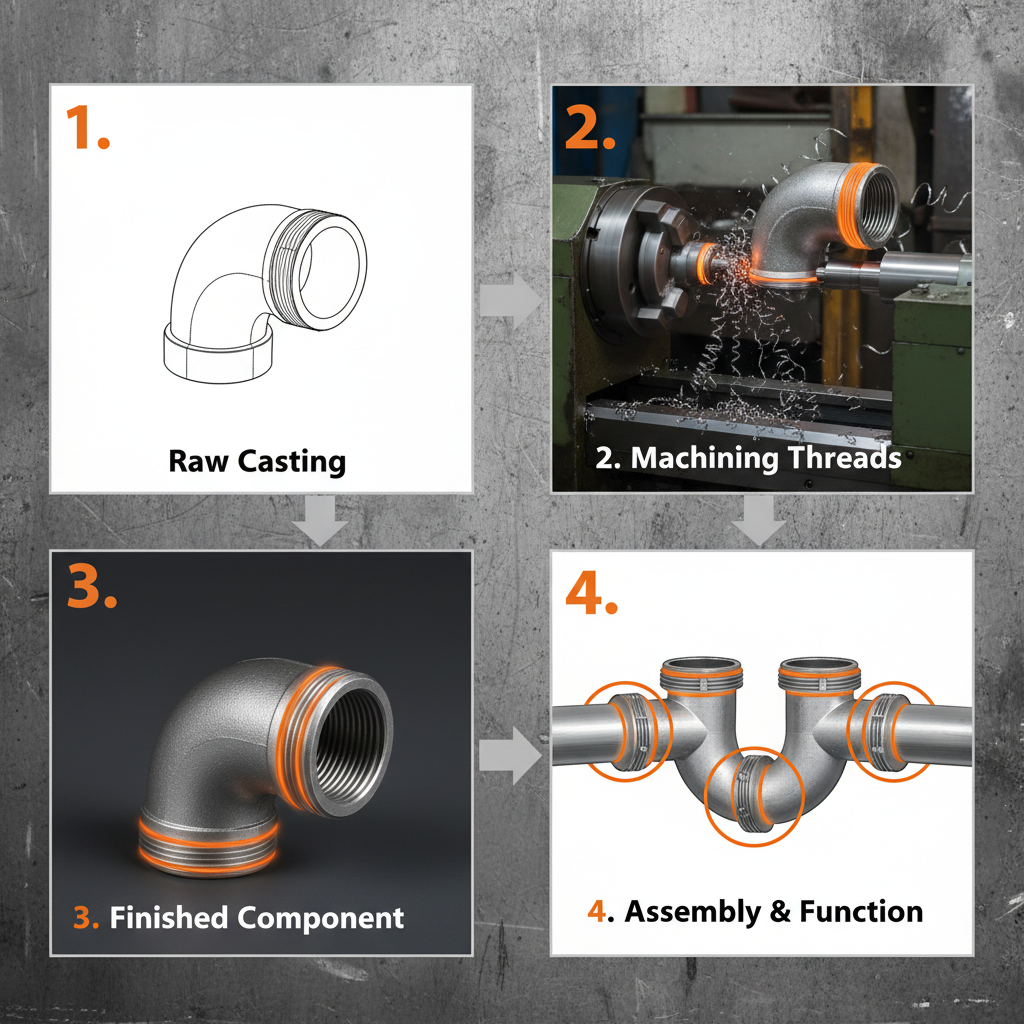
The global infrastructure for fluid transport relies heavily on the precision and reliability of the fitting pipe, which serves as the critical junction point in complex piping networks. From municipal water systems to industrial chemical processing, these components ensure that liquids and gases are directed safely and efficiently without leaks or pressure drops. Understanding the technical nuances of these fittings is essential for engineers and procurement specialists aiming to maximize system longevity and safety.
In the modern manufacturing landscape, the demand for high-performance alloys and strict adherence to international standards has transformed the way we approach pipe connectivity. The transition toward materials like ASTM B62 bronze and C83600 alloys reflects a global shift toward corrosion resistance and mechanical durability. By optimizing the interface between pipes, industries can significantly reduce maintenance downtime and prevent catastrophic failures in high-pressure environments.
Selecting the right fitting pipe requires a deep dive into material science, threading standards, and application-specific requirements. Whether dealing with standard water jointing or specialized industrial conduits, the integration of quality-controlled casting processes ensures that every connection meets rigorous safety benchmarks.
Material Composition and Casting Standards
The integrity of a fitting pipe begins with its chemical foundation. Utilizing ASTM B62 and UNS Alloy C83600 ensures a precise balance of Copper (84.6~85.5%), Zinc (4.7~5.3%), Lead (4.6~5.2%), and Tin (4.7~5.1%). This specific bronze composition is engineered to provide exceptional corrosion resistance, making it ideal for environments where water chemistry can degrade inferior metals.
The casting process is the heartbeat of production, where the temperature of molten iron is strictly monitored to prevent porosity. By adhering to ASME B16.15 Class 125 standards, the resulting components achieve a minimum tensile strength of 20.0kg/mm and an elongation of 20%, ensuring the part can withstand mechanical stress without fracturing.
Technical Specifications and Dimensional Accuracy
Precision in dimensions is non-negotiable when installing a fitting pipe in industrial settings. From the smallest 1/8 inch size (with a dimension 'A' of 0.27) to the larger 4 inch variants (dimension 'A' of 1.22), every millimeter is calculated to ensure a perfect fit. This accuracy prevents the common issue of "gap leakage," where slight variances in sizing lead to system failure.
The dimensional range is extensive, catering to various flow requirements. For instance, the 1-1/2 inch size offers a dimension 'B' of 1.38, providing the necessary clearance for high-volume water transport. These specifications are not merely suggestions but are strictly mapped to ensure compatibility across different manufacturers' piping systems.
Weight also plays a crucial role in system support calculations. A 1/8 inch fitting weighs approximately 8.8 grams, while a 4 inch fitting reaches 1620 grams. Understanding these weight variations allows engineers to design support brackets that prevent pipe sagging and joint stress over time.
The Role of Threading and Seal Integrity
The effectiveness of a fitting pipe is largely determined by its threading. By conforming to NPT standards and ASME B1.20.1, these fittings ensure a tapered seal that tightens as it is screwed in. This mechanical advantage is critical for creating airtight and watertight junctions without relying solely on chemical sealants.
In practical application, the threading process involves rigorous in-process checking using specialized gages. This ensures that the fitting pipe threads are neither too tight (which could strip the metal) nor too loose (which would compromise the seal), maintaining a consistent tolerance across thousands of units.
Beyond the threads, the internal surface finish of the casting is optimized through grinding. By removing casting burrs and imperfections, the flow of water remains laminar, reducing turbulence and preventing the buildup of sediment at the joint, which is a common cause of long-term clogging.
Performance Metrics in Water Pipe Jointing
When evaluating a fitting pipe for water jointing, the most critical metric is the leak-proof rating. Every single piece must undergo a 100% water pressure test. This ensures that the casting is dense and free of micro-cracks, providing a reliability rating that is essential for residential and industrial plumbing where water damage could be costly.
The balance between tensile strength and elongation allows the fitting to absorb vibrations from pumps and thermal expansion and contraction. A tensile strength of 20.0kg/mm ensures the joint does not yield under pressure, while 20% minimum elongation prevents brittle failure during sudden pressure spikes.
Performance Ratings of Fitting Pipe Connection Methods
Quality Control and SOP Implementation
A rigorous Standard Operating Procedure (SOP) is what separates industrial-grade components from generic hardware. For every fitting pipe, the process begins with raw material checking to ensure the chemical composition of the bronze alloy matches the C83600 specification. Any batch that deviates from the prescribed copper or zinc percentages is rejected before casting even begins.
The quality control cycle continues through molding, rotary cooling, and grinding. The most critical phase is the 100% water pressure test, which acts as the final gatekeeper. By ensuring no leakage exists before the product enters the warehouse, the manufacturer guarantees that the end-user receives a component that will not fail upon installation.
Global Application Scenarios and Use Cases
In the realm of municipal water management, the use of a high-quality fitting pipe is paramount for preventing water loss. In coastal regions where salt-laden air accelerates corrosion, C83600 bronze fittings are preferred over standard iron because they resist oxidation, reducing the frequency of pipe bursts and expensive excavations.
Industrial zones, such as chemical processing plants or refineries, utilize these fittings for jointing water pipes used in cooling systems. The ability to maintain a seal under Class 125 pressure ratings ensures that cooling water is delivered consistently to machinery, preventing overheating and industrial accidents.
Furthermore, in remote infrastructure projects—such as irrigation systems in agricultural hubs—the durability of these fittings reduces the need for specialized maintenance crews. The ease of installation provided by NPT threads allows local technicians to secure connections reliably, ensuring that water reaches crops without wastage.
Comparative Analysis of Fitting Pipe Grades
Choosing between different grades of fitting pipe often comes down to a trade-off between initial cost and lifecycle value. While malleable iron may be more affordable for low-pressure internal applications, bronze alloys offer a significant advantage in longevity and corrosion resistance, which drastically lowers the total cost of ownership (TCO).
The dimensional consistency across the size range (1/8" to 4") allows for scalable system design. An engineer can specify the same material grade for a small sensor line and a main supply line, ensuring uniform chemical compatibility throughout the entire fluid network.
Ultimately, the integration of strict SOPs and international standards like ASME and ASTM creates a benchmark for reliability. When a fitting is 100% water-tested and cast from verified alloys, it ceases to be a simple commodity and becomes a critical safety component of the infrastructure.
Technical Comparison of Fitting Pipe Material Specifications
| Material Grade |
Corrosion Resistance |
Tensile Strength |
Application Suitability |
| C83600 Bronze |
Excellent (10/10) |
20.0 kg/mm² |
Marine & Potable Water |
| ASTM B62 |
High (9/10) |
19.5 kg/mm² |
General Plumbing |
| Malleable Iron |
Moderate (5/10) |
17.0 kg/mm² |
Dry Industrial Lines |
| Coated Steel |
Good (7/10) |
22.0 kg/mm² |
High Pressure Gas |
| C89633 Alloy |
Very High (9/10) |
20.0 kg/mm² |
Industrial Cooling |
| Standard Brass |
Moderate (6/10) |
15.0 kg/mm² |
Low Pressure Domestic |
FAQS
For corrosive environments, ASTM B62 or UNS Alloy C83600 bronze is highly recommended. These materials contain a specific balance of copper, zinc, and tin that creates a natural resistance to oxidation and chemical erosion. Unlike standard iron, bronze fittings do not rust when exposed to moisture or salt, making them the gold standard for marine and outdoor water systems.
Reliability is guaranteed through a two-step verification process: first, the threads must conform to NPT and ASME B1.20.1 standards to ensure a mechanical taper seal. Second, every single piece must undergo a 100% water pressure test. If a fitting passes this test, it means there are no internal casting voids or surface cracks, ensuring a leak-proof installation.
Class 125 refers to the pressure-temperature rating according to ASME B16.15. It defines the maximum pressure the fitting can safely handle at a specific temperature. A Class 125 rating is standard for most water jointing applications, providing a robust safety margin for residential and light industrial use without being over-engineered and unnecessarily expensive.
Yes, our fittings are designed for global compatibility. By utilizing NPT (National Pipe Taper) threads and adhering to ASTM and ASME standards, these components can be integrated into piping networks worldwide. This standardization ensures that whether you are in Asia, Europe, or the Americas, the fitting pipe will align perfectly with compliant pipes and valves.
While the lifespan of bronze fittings can extend for decades depending on the environment, we provide a minimum 1-year guarantee. This covers manufacturing defects in the casting and threading. However, because of the use of high-grade alloys like C83600, the actual service life often far exceeds the warranty period, especially in potable water applications.
When receiving bulk shipments, you should verify three things: the brand marking (e.g., "P"), the packaging integrity (5-layer corrugated master cartons), and the size markings. It is also recommended to perform a random thread gauge test to ensure the NPT taper is consistent with the ASME B1.20.1 standard provided in the technical documentation.
Conclusion
The selection of a high-quality fitting pipe is a fundamental decision that impacts the safety, efficiency, and longevity of any fluid transport system. By focusing on ASTM B62 and C83600 bronze alloys, adhering to NPT threading standards, and implementing a 100% water-test quality control protocol, manufacturers can eliminate the risks of leaks and corrosion. The synergy between precise dimensional accuracy and material strength ensures that these components perform reliably under the pressures of modern industrial demand.
Looking forward, the industry will continue to move toward even more stringent quality certifications and sustainable casting processes. For procurement officers and engineers, the key to success lies in prioritizing verified SOPs and material certifications over low-cost alternatives. Investing in precision-engineered fittings today prevents the catastrophic costs of system failure tomorrow. Visit our website for more technical data: www.malleablefitting.com